What does bus franchising turn your Authority into?
Franchising changes more than governance. Under a gross-cost model, the Authority sets the passenger proposition, receives fare revenue and carries the risk if patronage does not materialise.
People search for
In this article
Franchising shifts responsibility for routes, fares and standards to the Authority. Under a gross-cost model, the Operator delivers the specification while the Authority receives fare revenue and carries demand risk.
The Authority is now responsible for growing revenue, but may not yet have the commercial capability to do so.
The Authority remains a public body. Accessibility, affordability and necessary services still matter. It must understand customers, manage demand and know how decisions affect income and cost.
Before franchising goes live
Bus patronage outside London peaked in 2009. By March 2025, journeys had recovered to 93 per cent of their pre-pandemic level, but journeys per person remained 33 per cent below the 2009 peak.
A return to pre-pandemic patronage would restore a trend that was already falling.
Franchising gives the Authority control of the network, fares, ticketing, brand, information, customer experience and Operator incentives. The Authority must use these levers together.
An Authority that receives the fare revenue without a plan to grow it has accepted revenue risk without creating a growth strategy.
A network-wide forecast is not a demand model
Many Authorities have not forecast fare revenue by route and hour. A network assumption may support a funding model, but cannot show where to add frequency, hold a fare or redesign a weak customer journey.
A useful demand model connects boardings and revenue to route, direction, time, day type and fare product. It also records context. A fall may reflect poor punctuality, a timetable change, a fare decision or a weak customer experience.
Section 143A of the Transport Act 2000 allows a franchising Authority to require specified passenger, fares, revenue, mileage, staffing and forecast information for its franchising functions. Test and reconcile it before using it as a commercial baseline.
The Operator and Supplier contracts must state what data the Authority receives, how often, at what quality and what happens when it is wrong.
The business model must connect five disciplines
| Business discipline | Decision the Authority must be able to make |
|---|---|
| Network and product | Where can a service change create useful journeys rather than mileage alone? |
| Fares and ticketing | Which price or product removes a barrier without damaging yield? |
| Customer experience | Which failures prevent first use or make existing passengers leave? |
| Distribution and information | Can people find, understand and buy the service across physical and digital channels? |
| Evidence and investment | Which intervention changed patronage or revenue, and should it be scaled? |
Customer experience is not a discretionary extra to be trimmed when finances tighten. When the Authority depends on fare revenue, customer experience becomes part of the revenue infrastructure.
Designing franchising for patronage and revenue growth
A demand model identifies where growth may be possible. The Authority must then use a repeatable cycle: establish a baseline, identify an opportunity, design an intervention, forecast its effect, test it and decide whether to scale, adapt or stop.
ITA’s services and products support this cycle. LiteFranchise™ connects network control, patronage plans and Operator incentives. Gleaming Fleet protects cleanliness and working passenger systems. The bus stop information model helps non-users understand the service. TellUs addresses a safety barrier. OneContact exposes recurring customer failures.
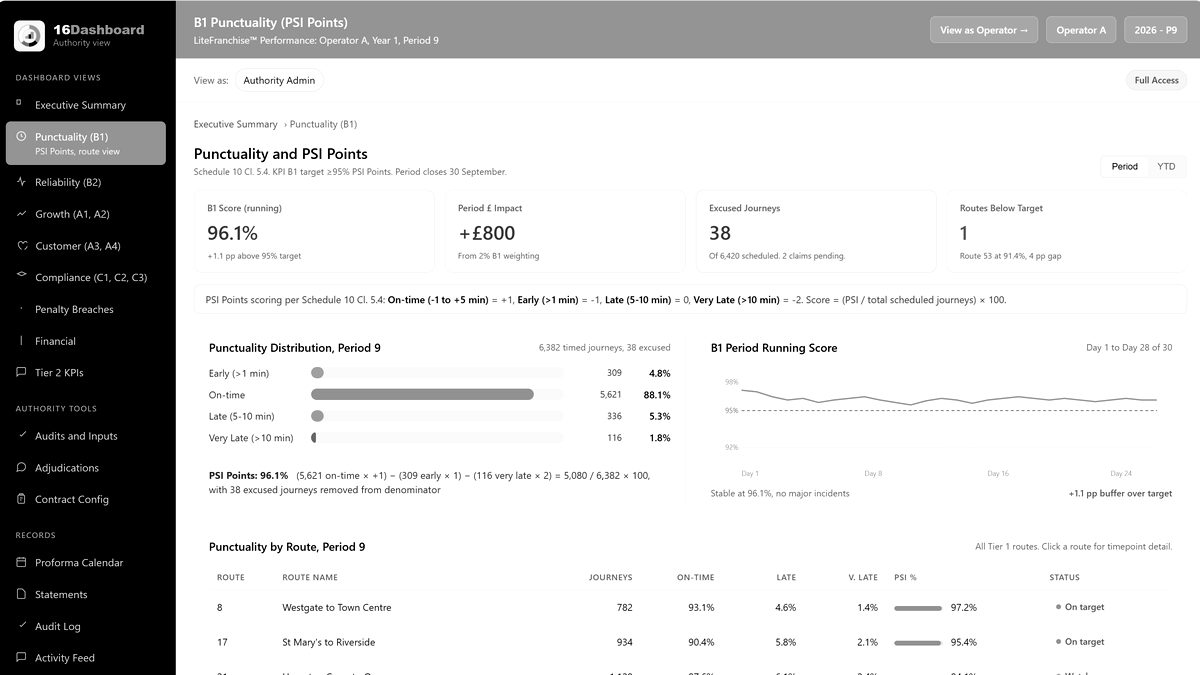
IDInsight brings patronage, revenue, operational, fleet and asset information into one view. 16Dashboard connects evidence to contract governance and payment. They help an Authority deliver, measure and improve its proposition.
Operators remain part of the growth model. Contracts can require route-level plans, named leads, reliable data and evidence. Incentives can reward verified impact without transferring uncontrolled revenue risk.
Ownership of patronage and revenue growth
An Authority can manage without a large commercial department, provided it has an executive owner for patronage and fare revenue performance, supported by the necessary network, fares, customer, data, finance and contract capability.
The Target Operating Model should give that owner decision rights and establish a regular commercial review. That review should explain what changed, why it changed, what action followed and whether it worked. A presentation of historic totals is not commercial management.
Patronage and fare revenue growth cannot make every socially necessary service self-funding. It can reduce avoidable pressure for additional subsidy or taxation. The objective is to earn more income and public value from the network while protecting the obligations that justify public control.
Useful questions
Before franchised services begin, an Authority should ask:
- Who is accountable for patronage, fare revenue and the customer proposition across the network?
- Can we forecast revenue by route and time or only repeat a network-wide assumption?
- Do Operator contracts require the data, growth capability and evidence needed to manage revenue risk?
- Is customer experience funded and governed as part of the growth model?
- What decisions can the commercial review make when patronage or revenue moves away from plan?
More on Franchising & Procurement Strategy
 Data & GovernanceArticleIs your data strategy built for compliance or for growth?Franchising & Procurement StrategyArticleHow to build a bus franchising business case that can withstand scrutinyFranchising & Procurement StrategyArticleIs your organisation ready to run a bus network, not just award bus contracts?