Is your data strategy built for compliance or for growth?
Publishing open data and meeting reporting deadlines are necessary. They do not tell an Authority which route, journey or customer problem is worth investing in.
People search for
In this article
Franchising can give an Authority revenue risk before it has built the data capability to manage it.
A compliance strategy checks that information arrived correctly and on time. A growth strategy uses it to decide where to intervene and whether the last action worked.
What matters is whether the data is structured to inform a decision.
Start with a baseline
A patronage target set against an unreliable baseline is a dispute waiting to happen. LiteFranchise™ requires at least 12 months of route-level boarding data, with 24 preferred where available. It separates route, month, day type and fare media, then refreshes the data during mobilisation so the contractual baseline is current.
History helps only when records are comparable. Route identifiers change, revenue may be recorded by sale rather than journey and payment types may sit in different systems. Profile and reconcile the data before relying on it.
Use the statutory power carefully
Section 143A of the Transport Act 2000 allows an Authority to acquire relevant Operator information. This includes journeys, fares, revenue, mileage, employees and forecasts. Regulations add costs and vehicle information. A request cannot reach back more than five years.
The Authority does not acquire unrestricted ownership. It obtains information for franchising functions, and use and sharing are limited. Each request should support a defined decision.
The statutory power supports the Authority's preparation; live contracts govern the future service. They should state which data the Authority owns or may use, who produces it, and the fields, standards, frequency, quality and correction times. They should cover source access, audit, retention and exit.
“The Authority owns all data” does not set an operating requirement. Contracts must name the records, rights and responsibilities.
Connect compliance, growth and customer evidence
Bus Open Data Service compliance is essential. Timetables, fares and vehicle locations support passenger information and operational analysis. Those sources do not by themselves provide a commercial view of demand.
A growth data model needs to connect several types of evidence.
| Evidence layer | Decision it should support |
|---|---|
| Open and operational data | Is the planned service being delivered and published correctly? |
| Ticketing and revenue | Which routes, times, products and passenger groups are changing? |
| Customer contacts | Which recurring failures create effort or lost confidence? |
| Safety reporting | Where and when do concerns cluster, and what response is needed? |
| Fleet and asset information | Are faults, cleanliness or failed passenger systems affecting the offer? |
| External context | Could weather, events, roadworks or local change explain the result? |
Linking the evidence gives the Authority a basis for investigation. If evening patronage falls alongside poor punctuality, safety concerns or failed information, the Authority can direct resources and test whether the response worked.
Turn the baseline into action
A baseline matters when it informs a decision or has a contractual consequence.
LiteFranchise™ links the Annual Patronage Target to validated ticketing data by transaction type. It assesses Operator-led initiatives against evidence rather than activity. Each initiative should specify the route or passenger group, expected journeys, measurement period, lead and attribution method.
This avoids treating correlation as causation. Patronage may rise because fares changed, an event took place or mileage increased. Account for those factors and use a suitable comparison where possible.
Use AI once the foundation is established
Artificial intelligence and machine learning can find route and time patterns, forecast demand and flag unusual revenue movement. They can test links with weather, events and service changes.
They cannot repair missing data, prove that a campaign caused growth or decide whether a necessary journey should run. Inconsistent records still produce unreliable results.
Compare transparent forecasts with actuals. Add complexity only when decisions improve. Every model needs an owner, stated purpose, tested accuracy and human challenge.
Build one operating view
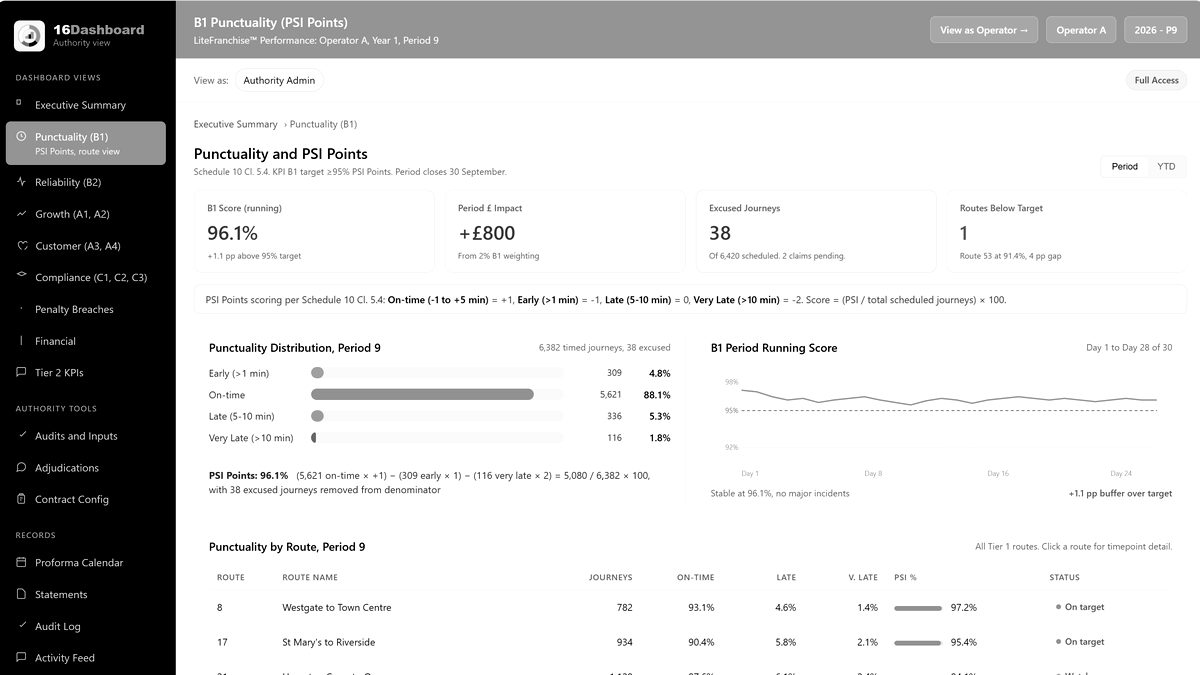
ITA’s products provide different parts of this operating view. IDInsight combines patronage, revenue, operational, fleet and asset evidence with AI-assisted alerts. 16Dashboard applies evidence to performance and payment. OneContact identifies customer-contact patterns. TellUs can show where passenger safety reporting concerns cluster, subject to safeguarding and privacy controls.
Public information should be machine-readable. Routes, fares, stops and disruption need to work in journey planners, search and AI services, not merely appear on a webpage.
The Target Operating Model should state who owns each data product, validates it and acts on the insight. A dashboard without an accountable decision-maker is only a more attractive report.
Useful questions
Before approving the data strategy or Operator contract structure, an Authority should ask:
- Can we produce a defensible patronage and revenue baseline by route, time and fare product?
- Have statutory information requests been designed around specific franchising decisions and legal use restrictions?
- Do the live contracts specify data fields, standards, quality, correction, audit and exit rights?
- Can we show which initiative changed patronage, rather than assuming that timing proves causation?
- Which decisions will each forecast or AI alert support, and who is accountable for acting on it?
More on Data & Governance
 Franchising & Procurement StrategyArticleWhat does bus franchising turn your Authority into?Franchising & Procurement StrategyArticleHow to build a bus franchising business case that can withstand scrutinyFranchising & Procurement StrategyArticleIs your organisation ready to run a bus network, not just award bus contracts?