Target Operating Model
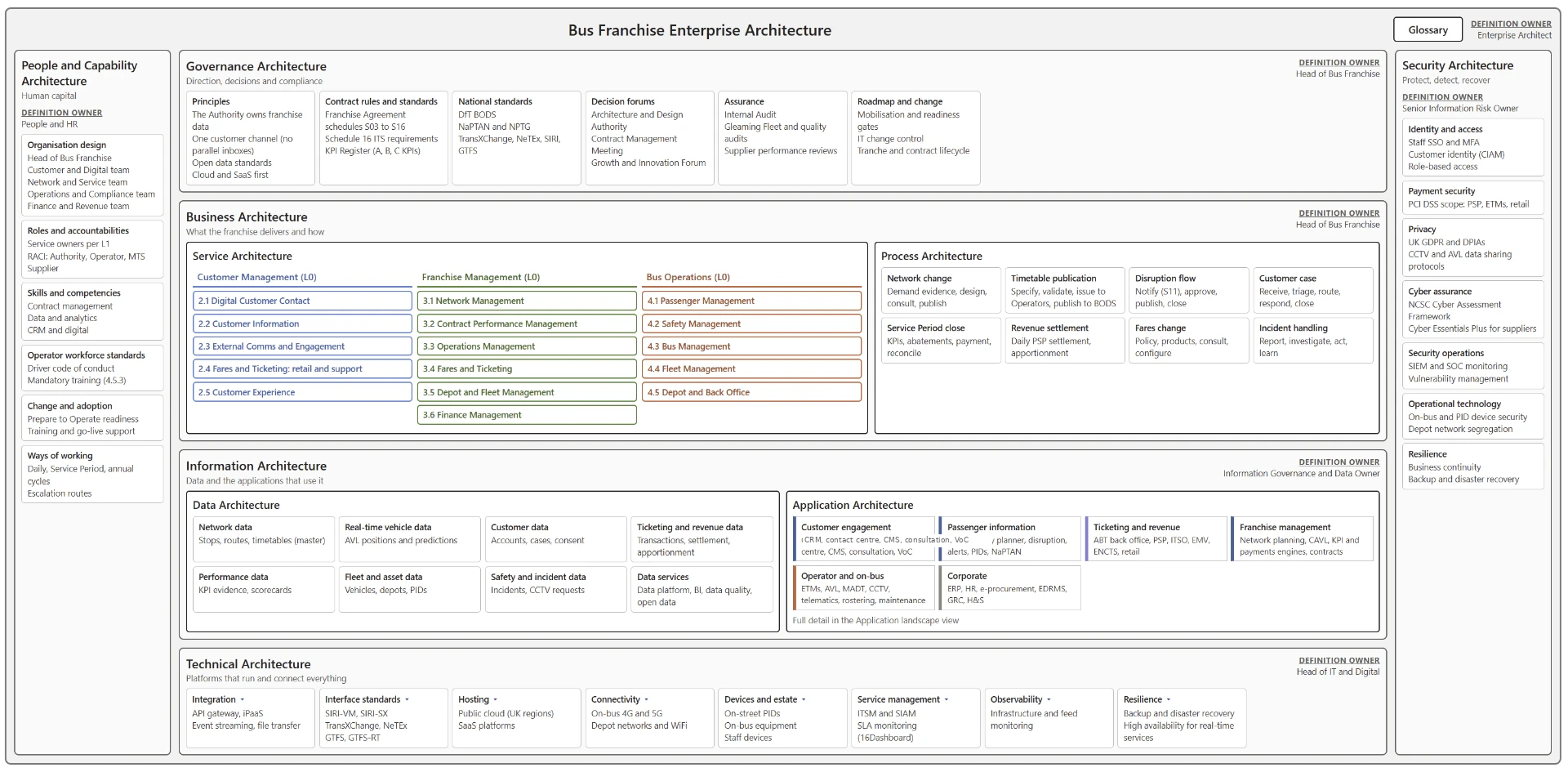
The services the Authority will run, who owns each one and how decisions are made. Most importantly, how do your teams own and use the model.
Operating Model and Technical Reference Model
Franchising turns an Authority from a funder into an owner of a transport network. We design the Operating Model for that role, and the technical architecture that underpins it.
Most reform programmes spend years on the procurement and too little on what happens after contract award. For Day-1 the Authority must plan and ensure service readiness for the network, manage contracts, handle customers efficiently, settle revenue, refunds and assure performance. Each of those needs people, decisions, processes and systems.
Without a defined Operating Model, roles overlap and gaps appear. Without a Technical Reference Model, systems are updated and procured in a disjointed manner and may not join up.
The services the Authority will run, who owns each one and how decisions are made. Most importantly, how do your teams own and use the model.
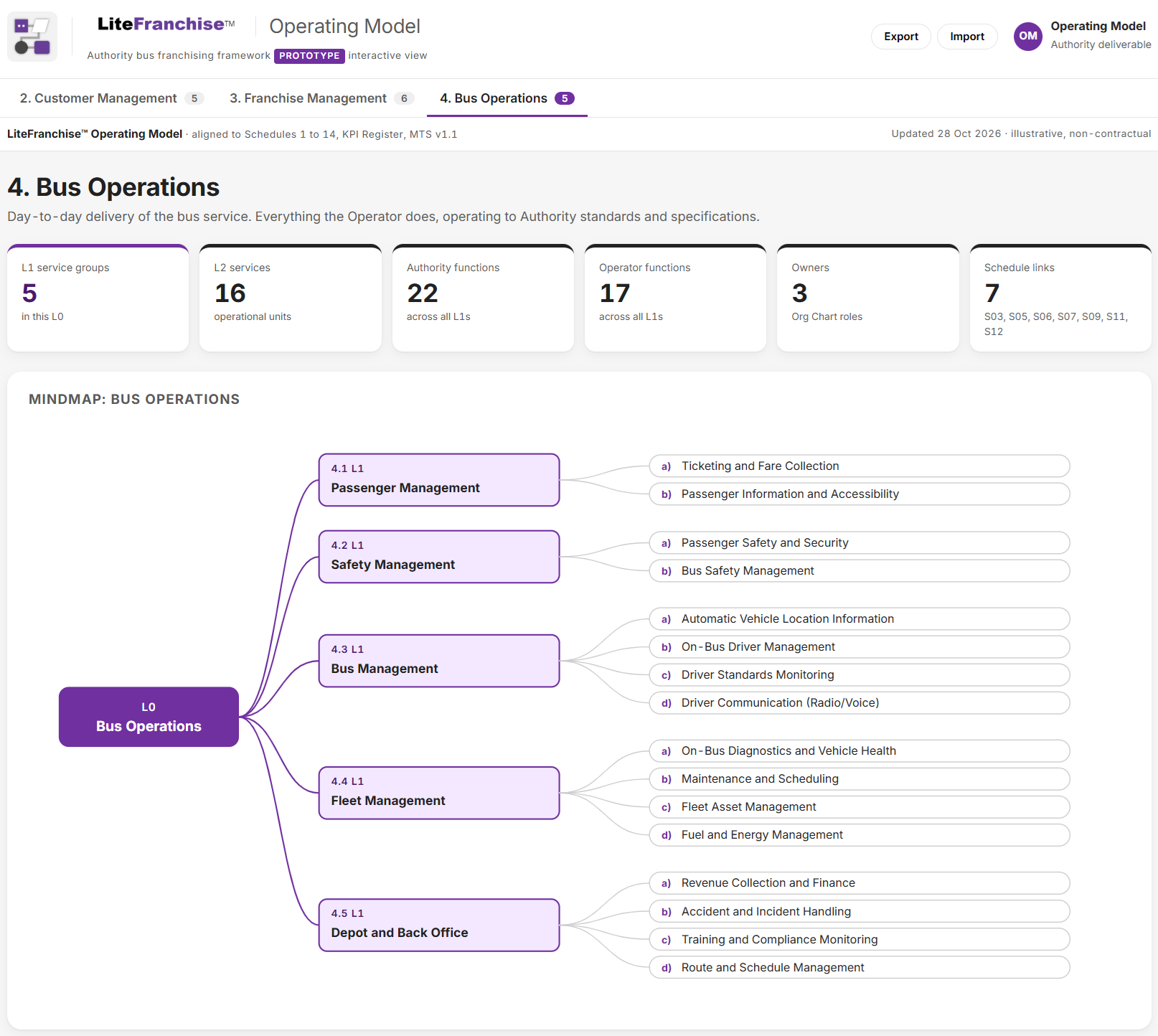
A layered service model from top-level domains down to individual services, with a named owner for each.
Team structure, roles and the minimum resource model, with transition from today's structure. We also have defined job descriptions and skill-sets required for key roles.
Decision forums, escalation routes and the service relationships between the Authority, Operators and suppliers.
Every service mapped to the systems, interfaces and data that support it, who owns each system and what is needed for Day 1.
Business readiness for Day 1, early identification of TUPE obligations, training and change communications.
Our Operating Model follows the nine-layer framework: Customers, Products and Services, Operating Model, Locations, Organisation, People, Processes, Technology, and Data and Information.
Each L1 service entry card captures these layers plus Owner, Statutory basis, Delivery options, Capability and capacity, Interfaces and dependencies, Reporting (by cadence), and the Authority and Operator function split.
L2 sub-service cards expand into Purpose, Scope, Core Processes, Key Outputs, Reporting, Systems, and Governance. All fields are editable.
Right of Way training builds skills and knowledge for your teams.
Define the services, governance, resources and decision rights needed to run the chosen transport model.
View the Right of Way course
An Authority carrying fare-revenue risk needs the customer, product, revenue and investment disciplines of a commercial enterprise, applied within clear public-service guardrails.
Digital passenger services need reliable IT delivery. The Authority function accountable for the passenger journey should set their day-to-day priorities.
Franchising gives an Authority greater control of the network and brings day-to-day responsibilities that a contract alone cannot carry.